From Play to Purpose: How Serious Gaming is Transforming Education and Training
April 27, 2026
Find the Path That Fits Your Career Goals
Gaming is often dismissed as a distraction – something separate from “real” learning or work. But beneath the surface lies a rapidly growing field that’s reshaping how we teach, train, and solve complex problems: serious gaming, where play becomes a powerful tool for real-world impact.
What is Serious Gaming?
Serious games are digital applications designed for education and training, healthcare and therapy, workplace and corporate training, and public awareness and social impact.
These games use interactive mechanics to improve skills or knowledge, allowing players to practice in a low-risk environment, like emergency management or flight simulations. They borrow from game design elements, including immersion, engagement, and rewards, to teach skills, facilitate behavioural change, or simulate real-world scenarios.
It’s this potential that Dr. Kris Alexander – also known as “The Professor of Video Games” – has been championing. A Professor of Video Game Design at Toronto Metropolitan University’s The Creative School and Course Developer for the Certificate in Programming for Game Development, he is a leading advocate for the role of video games in enhancing teaching and learning. His talk, “How video games can level up the way you learn,” was featured at a TED Institute event in partnership with Destination Canada.
He recently led The Chang School’s first-ever Twitch livestream from the Red Bull Gaming Hub at Toronto Metropolitan University, bringing together current learners, prospective students, alumni, and industry professionals. In the Twitch session, he shared his perspective on serious gaming, reframing games not as entertainment, but as powerful engines for learning.
Following the event, Chang School Stories spoke with Dr. Kris to explore his perspective on serious gaming in greater depth.
“When you look at the core components of video games – audio, text, video, and interactivity – many educational studies talk about learning gains. Any time you have two or more of those components, learning gains are higher,” explains Dr. Kris. “The interactivity from video games adds autonomy in terms of what you trigger when your learning is going to happen. This is why when we leverage those tools [audio, text, video, and interactivity], we can connect with any discipline, like hospitals, health and wellness, or physical fitness and training.”
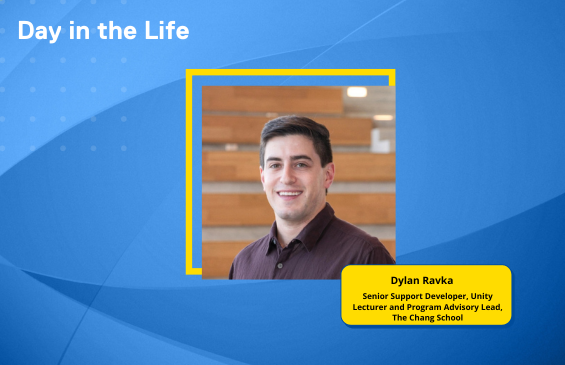
Likewise, Dylan Ravka, Instructor and Program Advisory Lead for the Certificate in Programming for Game Development at The Chang School and Senior Support Developer at Unity, says serious gaming takes what makes games engaging and applies it to learning and training.
“Serious gaming is all about using game design principles such as goals, feedback, challenge and progression for something beyond entertainment,” says Dylan, who also participated in the Twitch livestream event where some of the learners he instructs had a chance to demo their games. “The real value comes from making learning active instead of passive. It allows you to make decisions, see outcomes, and learn through experience.”
This combination of multimodal learning and learner control helps explain why serious gaming is so effective.
Why It Works: The Psychology of Play
Serious gaming is more effective than more traditional, passive forms of learning in that it incorporates a set of psychological principles that make it more engaging, effective, and lasting. There are several types of design features that actively involve the learner, creating conditions where skills are practiced, tested, and reinforced in real time. These include:
- Autonomy and learner control: Games mirror real-world decision-making as the learner decides when to act, how to approach challenges, and what strategies to use. Instead of being told what to do, learners go through their own trial and error process, deepening their understanding of their learning.
- Immediate feedback loops: Unlike more traditional learning environments, games offer instant, continuous feedback, letting the learner immediately know whether a decision worked or failed. This creates a loop of action → feedback → adjustment that speeds up skill development and helps refine their approach in a safe setting without high-stakes consequences.
- Built-in motivation and progression systems: Games are structured in a way that motivates learners by using progression systems like levels, achievements, and incremental challenges to create a sense of momentum and accomplishment. By tapping into intrinsic motivation, these systems encourage learners to persist, improve, and push through difficulty rather than disengage.
- Resilience through challenge: In gaming, failure is normalized as part of the process. In competitive games, players often lose repeatedly before mastering mechanics or strategies. This repetition builds resilience, adaptability, and perseverance – key skills that transfer beyond the game itself. As Dr. Kris notes, even choosing a weaker character can strengthen resilience, forcing players to rely on skill, strategy, and persistence to succeed.
Together, these elements create a powerful learning environment – one where failure is safe, progress is visible, and mastery feels both achievable and rewarding. It’s this foundation that allows serious gaming to extend far beyond entertainment and into meaningful, real-world applications.
Real-World Applications
Serious gaming spans a wide range of use cases, each leveraging these principles to drive learning and impact:
- Education and training: Teaching everything from medical procedures to soft skills and safety protocols
- Healthcare and therapy: Supporting rehabilitation, cognitive development, and mental health
- Workplace and corporate training: Strengthening team-building, leadership, and compliance learning
- Public awareness and social impact: Engaging audiences on issues like climate change, diversity, and civic participation
Dr. Kris gave the example of his wife who is a teacher for the Toronto District School Board and works inside of Sick Kids Hospital in Toronto. On one particular occasion, she noticed that two brothers who were hearing impaired were having difficulty communicating with her because she was wearing a mask and didn’t know sign language. Dr. Kris said he told her about an application called “Hand Talk”, which allows you to talk into your phone and then an avatar translates and does the sign language.
“My wife was able to use artificial intelligence and gaming technology via avatars to talk to the hearing impaired,” says Dr. Kris, adding this example shows how this kind of interactive, avatar-based communication are ways in which serious gaming can solve a real-world challenge.
Together, these real-world applications point to a larger shift: serious gaming isn’t just about using games as tools – it’s about building ecosystems that support their creation, testing, and impact at scale.
The TMU Model: Building a Serious Gaming Ecosystem
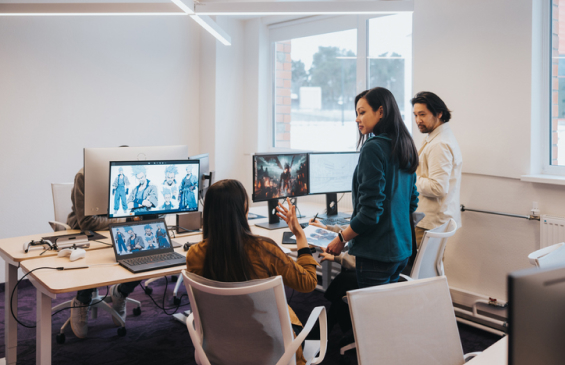
That’s where models like the Red Bull Gaming Hub come in. At TMU, the hub extends the principles of serious gaming beyond individual use cases in healthcare, education, or corporate training, and embeds them into a broader environment for innovation, collaboration, and skill development. Designed as both a classroom and a production space, it supports everything from game design and virtual production to esports broadcasting, while fostering research and industry partnerships.
Rather than simply consuming games, students and professionals in the hub are actively building simulations, experimenting with interactive technologies, and applying game-based learning to real-world challenges. This bridges the gap between theory and practice – turning ideas like medical simulations, AI-driven learning tools, or team-based training scenarios into tangible outputs.
That’s at the core of how Dylan approaches the course material in CKCS 510 - Technical Foundations for Game Developers and CKCS 520 - Simulating Force and Motion in Games, the two courses he instructs, with his learners.
“In my teaching, I use small game-based projects to help students learn concepts like physics and gameplay systems,” he says. “Instead of just explaining theory, they build something, test it, and iterate on it. These projects are designed with progression in mind. Each assignment builds on the previous one, so learners are continuously reinforcing and expanding their skills. You can see a clear difference in understanding when people learn by doing. They retain more, but they’re also able to apply those concepts more confidently.”
Crucially, the success of this model lies not just in the technology, but in its ecosystem. The hub brings together educators, students, and industry partners in a shared space designed for experimentation and community-building – an approach that has helped position it as a catalyst for innovation in gaming, education, and beyond.
“Students come to become better versions of themselves, academically, pedagogically, and not necessarily just from a playing standpoint,” says Dr. Kris.
In this way, the TMU model demonstrates how serious gaming can evolve from isolated applications into a sustainable, interdisciplinary ecosystem – one that prepares learners not just to engage with games, but to shape the future of how we learn, train, and solve problems.
Looking Ahead: The Future of Learning
As models like this continue to gain traction, serious gaming is emerging as a powerful cross-industry tool, with growing adoption across education, healthcare, and workforce training. What was once considered experimental is quickly becoming essential – driven by the need for more engaging, adaptive, and practical learning experiences.
What excites Dylan the most about the future of serious gaming in education and training is how accessible it’s becoming.
“These tools are no longer limited to large organizations,” he says. “More educators and developers can start building these experiences. I look forward to seeing how it continues to evolve. I think we’re moving toward a future where learning feels more engaging and interactive, rather than something people feel forced to do.”
At its core, this shift signals a broader transformation: a move away from passive instruction toward interactive, experiential learning, where learners don’t just absorb information – they actively apply it, test it, and evolve through it.
For those looking to be part of this shift, programs like The Chang School of Continuing Education’s Programming for Game Development certificate offer a direct pathway into the field. Designed to be completed online in as little as eight months, the program equips learners with in-demand skills in C++, C#, game engines like Unity and Unreal, and AI-assisted development – while helping them build a professional portfolio for careers in game development and interactive learning.
To learn more or explore the program, you can visit: