Why AI Training Can't Wait: Preparing People for the Future of Work
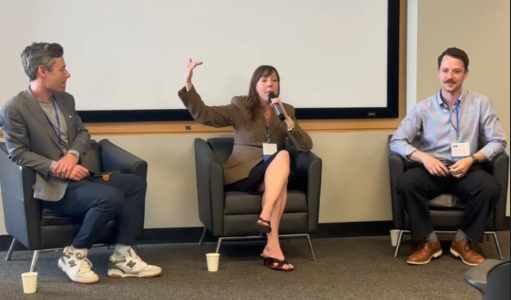 From left to right: Panel moderator André Côte, Dr. Sheri van de Pol, Founder, Cattlelytics, and Axel Smith Schon, Associate Vice President, AI Product, TD Bank Group.
July 24, 2026
Artificial intelligence is no longer a future skill — it is rapidly becoming a core workforce capability. Leaders across every sector, from financial services to manufacturing to healthcare, are discovering that successful AI adoption depends as much on workforce capability as it does on the technology itself. The corporate challenge extends far beyond purchasing the right tools; the real hurdle is equipping teams with the strategic knowledge to integrate AI into their daily operations safely and productively.
These themes were front and centre during a recent panel discussion, “From Experimentation to ROI,” at The Chang School’s AI in Action Summit. Leaders from banking, technology, and organizational learning explored what it really takes to implement AI successfully. While the panel featured impressive examples of AI transforming business processes, the overarching message for executive decision-makers was clear: organizations that prioritize investing in their people — not just the technology — will be best positioned to realize true business value.
AI Success Starts With People
The panel showcased how organizations across sectors are already realizing tangible returns from AI — but only when technology is paired with clear strategy and workforce readiness.
One of the panelists, Axel Smith Schon, Associate Vice President, AI Product, TD Bank Group, described how the bank's AI Prism initiative has helped streamline business processes, including deploying AI agents in real estate lending to reduce mortgage application processing times from hours to seconds. Success wasn't measured simply by implementing AI, but by defining clear business objectives, managing risk, and supporting employees through the change.
The conversation also demonstrated that AI's impact extends well beyond traditional office settings. Dr. Sheri van de Pol, Founder, Cattlelytics, shared how AI is transforming Canada's dairy industry through advanced analytics that track milk production, monitor herd health, and create digital twins of individual cows. These AI-powered models help farmers make more informed decisions, improve efficiency, and support more sustainable operations.
While the industries couldn't be more different, both examples reinforced the same lesson: AI delivers the greatest value when organizations focus not just on implementing technology, but on helping people understand how to use it effectively. This is the challenge many organizations are trying to solve. A structured workplace learning program like those offered by Corporate Training at The Chang School offers teams a way to adopt AI confidently and responsibly.
Ashton Cousineau, Director, Performance Solutions Lead, Global Learning and Development, Advisory at KPMG, says that it starts by helping employees understand how AI will reshape their work.
"It's not just about training on how to use AI, but really how work will look different and what AI might be moving in to take and create opportunities for people."
Ashton also spoke at the event on reframing AI adoption as a human and organizational challenge rather than a technical one with the goal of achieving successful integration through strategic workflow redesign and intentional employee support.
These are the kinds of challenges organizations across industries are facing today. As AI adoption accelerates, employers are turning to learning partners who can help develop workforce capabilities, encourage responsible AI adoption, and equip employees with the skills and confidence to effectively integrate AI into their day-to-day work.
Ready to prepare your workforce for AI?
From AI literacy to customized workplace learning, The Chang School's Corporate Training team helps organizations build the skills employees need to use AI confidently, responsibly and strategically.
The Hidden Cost Of Waiting
While organizations continue investing heavily in AI technologies, delaying investment in employee learning can come at a significant cost.
"I think the hidden cost is human," says Ashton.
When employees aren't given the opportunity to develop AI skills, uncertainty can quickly become resistance. People may worry about how AI will affect their careers or struggle to see where they fit in the future workplace.
Without a clear understanding of how work is changing, organizations risk disengagement, lower morale, and even the loss of talented employees.
Training, Ashton explains, isn't simply about teaching people how to use AI tools. It's about helping them understand the changing nature of work, identify new opportunities, and build confidence in their evolving roles.
This is where organizations need learning partners that can rapidly upskill teams to keep pace as technologies evolve. Professionals need opportunities to continually update their knowledge, experiment with new technologies, and develop practical skills they can immediately apply in the workplace.
Why Structured AI Learning Matters
Many professionals have already started teaching themselves AI through experimentation. While that curiosity is valuable, relying solely on self-directed learning can create inconsistencies and unnecessary risk.
Without structured training, employees may unknowingly expose confidential information, overlook privacy requirements, or develop workflows that don't align with organizational policies.
"We don't expect everybody to know everything," says Ashton. "If you leave people to their own devices, they will fill the knowledge gaps, but they're never going to address all of them."
Formal learning helps create a shared understanding of responsible AI use across an organization. Employees gain practical skills while learning how to evaluate outputs critically, protect sensitive information, and integrate AI into existing workflows in ways that support business objectives.
Rather than replacing curiosity, structured learning builds on it — giving professionals the confidence to use AI effectively while reducing organizational risk.
Learning Together Drives Better Business Outcomes
AI adoption also works best when employees learn together.
Ashton notes that team-based learning helps break down organizational silos and reduces duplicated effort as employees share ideas, learn from one another, and discover where AI can have the greatest impact.
"It breaks down silos," she says. "You're allowing people not just to learn together, you're allowing them to grow something together."
The panel highlighted similar lessons across industries. Whether implementing AI in financial services or using machine learning to improve dairy farming operations, organizations saw the greatest success when AI was introduced alongside workforce planning, collaboration, and ongoing learning. Panelists consistently emphasized that AI is most effective as a tool to augment employees' expertise rather than replace it.
Building AI capability across teams also creates a culture of innovation. Instead of isolated experimentation, organizations develop shared best practices, improve collaboration, and ensure employees are using AI consistently and responsibly.
Lifelong Learning Is The Foundation Of An Ai-Ready Workforce
As AI continues to reshape jobs across every sector, one thing is becoming increasingly clear: learning can no longer be a one-time event.
Professionals will need to continually build new skills as technologies evolve, while organizations should strive towards creating learning cultures that help employees adapt with confidence. Corporate Training offers a practical pathway to keep pace with rapid technological change, providing opportunities to develop in-demand AI skills while applying them to real workplace challenges.
For employers looking to accelerate AI adoption, investing in workforce development may ultimately deliver a greater return than investing in technology alone.
Because every organization’s AI journey is different, Corporate Training offers a customized approach to curate the learning experience to reflect the organization's industry, workforce, and business goals. The Corporate Training team partners with organizations to design customized learning solutions that help employees build practical AI knowledge, strengthen digital capabilities, and confidently navigate workplace transformation. By combining industry expertise with flexible learning experiences, organizations can equip their teams with the skills needed to use AI responsibly, strategically and effectively.
Because the future of work won't be shaped by artificial intelligence alone — it will be shaped by people who know how to use it well.