
Turning People Data into Business Strategy: Insights from People Analytics Graduates
August 21, 2026
Organizations are collecting more workforce data than ever before — but data alone doesn't improve workplaces. The real value comes from HR professionals who can bridge HR expertise with data analytics to make more strategic business decisions.
That's why people analytics has quickly become one of the fastest-growing skill sets in human resources.
The Chang School's People Analytics for HR Professionals Postgraduate Certificate is one of its professional certificates, created to equip HR and business professionals with exactly these capabilities. This year, the program celebrated an important milestone as its first cohort of graduates completed the certificate.
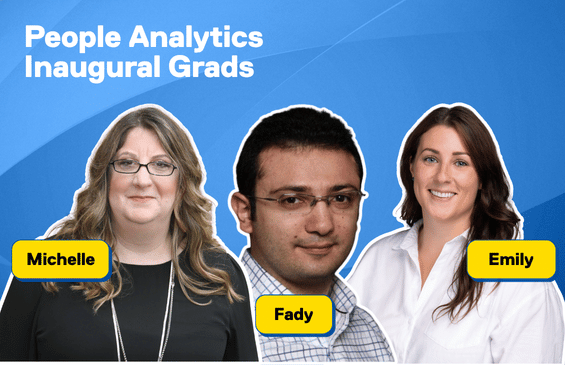
We spoke with three members of that inaugural cohort: Fady Barsoum, HR Coordinator, University of British Columbia, Michelle Haft, HR Director, and Emily Surrette, HR Professional working in Indigenous relations, about why they chose the program, what surprised them most, and how they're already applying people analytics in their careers.
The Chang School: Why are people analytics skills becoming so important?
All three graduates agree that organizations need HR professionals who can transform workforce data into business insight.
Fady: Organizations have more workforce data than ever before, but data alone doesn't improve decision-making. HR professionals need to interpret trends and translate them into recommendations that align with business goals.
Michelle: People decisions deserve the same level of rigor as operational decisions. People analytics doesn't remove the human stories — it strengthens them with meaningful, actionable evidence.
Emily: Payroll is often one of an organization's largest expenses, and people-related challenges like turnover, disengagement and lost productivity have real financial impacts. People analytics helps demonstrate both the cost of inaction and the return on investing in people.
TCS: What inspired you to pursue people analytics?
Fady: I was interested in people analytics because I wanted to strengthen my ability to use data to support evidence-based HR decisions and transition into the next phase of my career.
Michelle: I've worked in HR for most of my career and spent many years supporting HR programs, reporting and analytics teams. Much of what I learned came through experience, but I wanted to understand *why* people analytics works and the methodology behind different forms of analysis.
Emily: I could already see the importance of investing in people and the positive outcomes that come from making the right decisions. What I didn't know was how to take those ideas and put them into practice. Learning people analytics helped bridge that gap.
TCS: Why did you choose this certificate?
Although each learner came from a different background, flexibility and practical learning were common themes.
Fady: The curriculum combined HR, analytics and business strategy in a practical way. The online format made it possible to balance full-time work while progressing from foundational concepts to more advanced applications.
Michelle: I was drawn to The Chang School's strong reputation, flexible delivery and the rigor that had gone into developing the certificate. TMU also has a personal connection for me because my father graduated from the university.
Emily: I was impressed by how the program challenged the perception that HR decisions are based only on instinct. The courses focused on using data to solve business problems and evaluate whether recommendations actually produce results.
TCS: What was the biggest lesson you took away?
Fady: My biggest takeaway was learning how to tell a story with data. People analytics isn't simply about running reports — it's about presenting evidence in a way that supports better decision-making.
Michelle: I learned to evaluate data more critically by questioning how it's collected, validated, and presented. Understanding the methodology behind an analysis gives me greater confidence in the insights I'm sharing.
Emily: Knowing your audience completely changed how I communicate insights. Leadership doesn't always need every detail — they need the right information presented clearly enough to make confident decisions.
TCS: Was there a moment when everything clicked?
For each graduate, confidence came from applying what they had learned.
Fady: My 'aha' moment came during the capstone project. I realized the goal wasn't producing more charts — it was building a clear, evidence-based story and making recommendations that could be defended.
Michelle: The biggest surprise was realizing my classmates were facing many of the same challenges I was. Learning alongside peers and sharing experiences made the program especially meaningful.
Emily: In one assignment there wasn't a single right answer, so I wasn't sure whether I was approaching it correctly. Receiving positive feedback confirmed that I had connected everything we'd learned and really understood the bigger picture.
TCS: How has the certificate influenced your work?
Each graduate says the learning has shaped how they approach their roles.
Fady: The program strengthened my analytical thinking and changed how I approach HR reporting. I'm continuing to build technical skills so I can apply people analytics to workforce planning and organizational change.
Michelle: I've always believed in the value of people analytics, but earning the certificate has added credibility to the conversations I'm having with leaders. They have confidence in the insights and recommendations I bring forward.
Emily: I've shifted from simply identifying trends to asking deeper questions like, “What other data supports this? Is there historical context? What could this look like five years from now?” It's helped me become much more strategic in my thinking.
Ready to build one of HR's fastest-growing skill sets?
Learn how The Chang School's People Analytics Certificate can help you turn workforce data into strategic business insights — and advance your career in HR.
TCS: How did you balance continuing education with work and life?
Despite demanding careers and personal commitments, all three graduates found the online format made the program achievable.
Fady: The flexible delivery made it possible to balance full-time work and family while completing the program.
Michelle: As a single parent of two, the evening classes and online course materials allowed me to study around work and family responsibilities.
Emily: I appreciated that instructors understood students were working professionals, and made themselves available outside scheduled class time when extra support was needed.
TCS: What would you say to someone considering the certificate?
Fady: I'd especially recommend it for professionals who want to move from administrative HR into more strategic work. At the same time, many experienced practitioners in the program were there to sharpen existing analytical skills.
Michelle: Just do it. Whether you're an HR generalist, HR business partner, analyst, or data lead, you'll gain practical knowledge that's valuable across industries and career stages.
Emily: If you're passionate about HR, I'd absolutely recommend it. Even if you don't ultimately specialize in people analytics, the skills you develop can be applied across virtually every area of the profession.
Looking Ahead
Although their careers are taking different paths, all three graduates plan to continue building on what they've learned.
Fady hopes to continue developing his technical and analytical expertise while moving further into strategic HR. Michelle is focused on helping organizational leaders use workforce data to make stronger business decisions. Emily plans to keep applying her new perspective while exploring where her career will take her next.
Together, their experiences reflect a broader shift happening across today's workplaces. As organizations seek to make smarter, evidence-based decisions about their people, professionals who can connect HR expertise with data literacy are becoming increasingly valuable.
For this inaugural group of graduates, the People Analytics Certificate has provided more than new technical skills — it has given them the confidence to ask better questions, communicate stronger recommendations and help shape the future of work.
Learn more about the Postgraduate Certificate in People Analytics for HR Professionals